
A RAD Recipe for Collective Action
A 5-minute read written by Victoria “Toia” Santamarina
Collaboration is having a moment, and we’re happy to see it! Everyone, across sectors, is talking about partnerships, ecosystems, and coalitions as the way forward, and we couldn’t agree more. However, after years of working collaboratively alongside leaders across sectors, places, and movements, we’ve learned a thing or two, starting with the fact that it is far easier said than done.
Coalitions don’t succeed just because people want to work together or agree on a certain topic. They succeed when a group of people builds a strategy with the right conditions to act together.
At Radical Partners, coalition-building is not a theory or a practice we take lightly. It’s a practice we’ve tested in real time across arts education, gender equity, workforce development, climate resilience, and civic engagement over the past 10+ years. From Arts Access Miami to GET Champions Miami, to the local wins of the 10 Days of Connection and national initiatives, we’ve seen what helps coalitions move from good intentions to shared impact. We’ve also failed along the way, and over time, a clear pattern emerged.
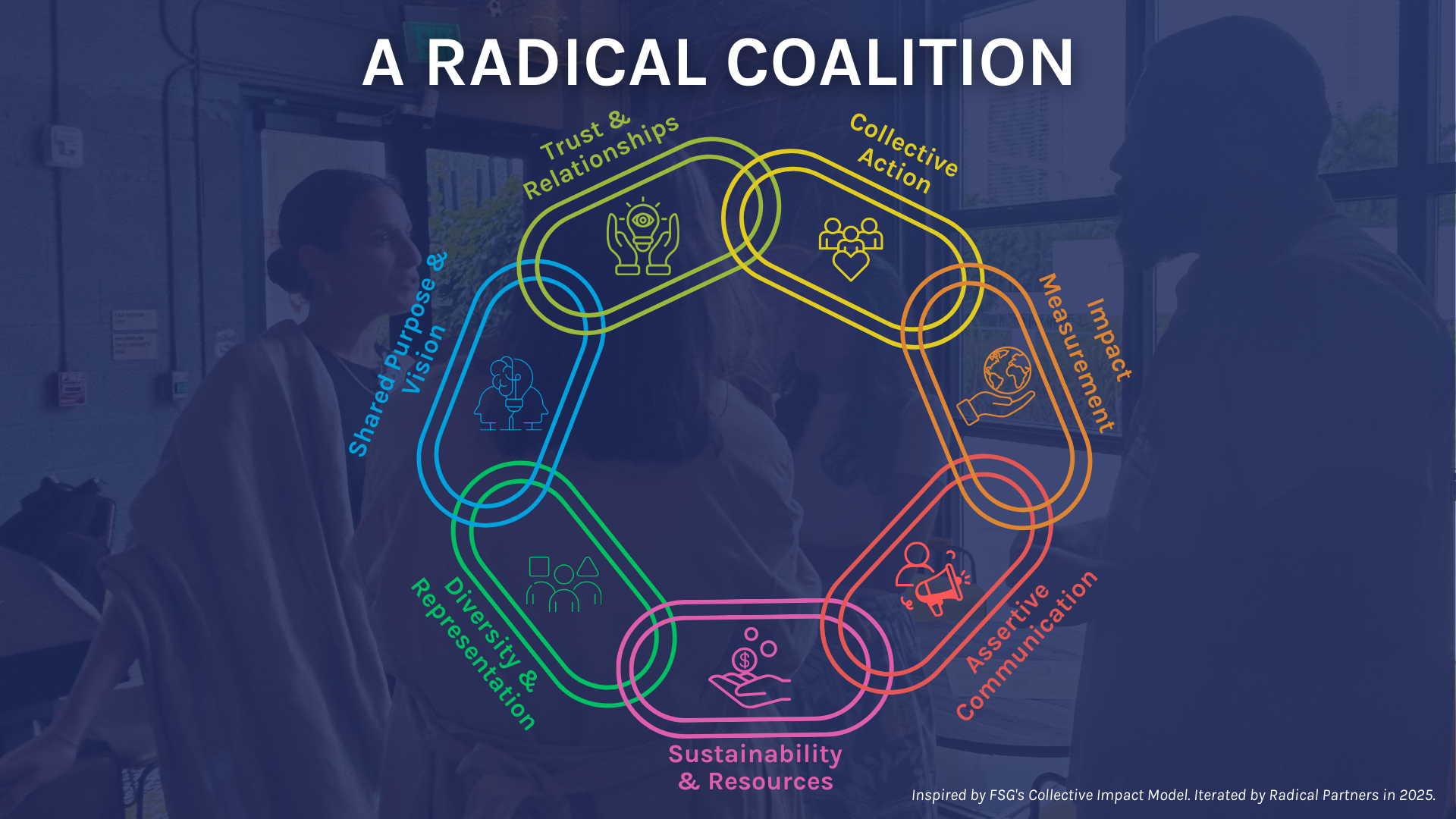
The coalitions that endure and deliver results are built on a specific set of elements. Miss one, and the whole system strains. Tend to all of them, and collective action becomes possible. We call it the RAD Recipe for Collective Action, and we’re happy to share it with you here.
Many of the foundations of our coalition-building approach are based on the Collective Impact Model established by our friends at Collective Impact Forum and its five key conditions. At the core, effective coalitions are anchored in:
A shared purpose and vision that goes beyond a polished mission statement and reflects a genuinely co-owned “why,” making space for…
Collective action, where roles are clear, efforts are coordinated, and partners understand how their work connects to the whole.
Progress is sustained through impact and measurement, using shared indicators and data practices not just for performance tracking, but for learning, adaptation, and accountability to community outcomes. None of this works without…
Assertive communication, including transparent decision-making, honest feedback loops, and storytelling that aligns internal partners and invites external engagement.
Holding these elements together is the often invisible but essential backbone function, the dedicated capacity that convenes partners, maintains momentum, supports alignment, and tends to the infrastructure that allows collaboration to move from intention to impact.
Practice has shown us that this framework is tremendously helpful and also not enough.
What It Really Takes to Build Coalitions That Last:
In current coalitions, especially those working across differences, power, and lived experience, the formal structures of Collective Impact need additional conditions to truly hold. At Radical Partners, our on-the-ground work has revealed three critical elements that often determine whether a coalition sustains momentum or slowly unravels:
6. Trust and relationships,
7. Diversity and representation, and
8. Sustainability and resources.
These are not add-ons,they are the connective tissue that allows shared purpose, action, measurement, and communication to function under real-world pressures.
Trust and Relationships:
Coalitions are made of people, not logos. Strong interpersonal relationships create the foundation for collaboration, accountability, and healthy conflict. Trust doesn’t mean avoiding disagreement; it means having the relationships needed to work through it with honesty and care. We invest time here because without trust, coordination becomes compliance, and momentum stalls.
Pro-tip: Even when trust is built, it needs to be maintained. People and organizations evolve, and so should the conditions of relationships over time.
Diversity and Representation:
Coalitions are only as strong as the voices they include. Representation across lived experience, sector, geography, and identity is not a “nice to have,” it’s essential for equity and effectiveness. When diverse perspectives shape strategy and decision-making, coalitions are better equipped to understand the system they are trying to change and to design solutions that actually work.
Pro-tip: A common mistake is to leave the voice of the target audience out of the conversation. E.g: When building a coalition for youth, have youth shape it with you. When building a coalition for mothers, have mothers shape it with you.
Sustainability and Resources:
No coalition thrives on passion alone. Long-term impact requires thoughtful resource planning, from funding and staffing to time and energy. Sustainability means designing coalitions that can weather leadership changes, funding shifts, and external shocks without losing their core purpose.
Pro-tip: Ideally, you want to start a coalition with funding secured. If that is not the case, be sure to discuss with coalition members what each of the players will support. Who lends the space for the meetings? Who pays for the breakfast? Who will sponsor the staff time that is going to be a part of it?
From Framework to Practice.
As with any recipe, this didn’t come to life after one try. It came from practice; from moments of success and from painful ones as well. Each of the elements shared above reflects lessons learned alongside partners who are navigating real constraints, real power dynamics, and real urgency, while trying to implement real change.
To top it all off, coalition-building is not linear. These elements are deeply interconnected, reinforcing one another over time. Strengthen one, and you support the whole; Ignore one, and cracks begin to show.
At Radical Partners, our role is often to help coalitions design, start, and sustain these conditions intentionally; from convening the right people to staying grounded in purpose, hope, and reality.
Remember, collaboration is no longer just a nice-to-have or a value to hold; it’s a bold, smart, and kind strategy that, when done well, it’s one of the most powerful tools to build more equitable and resilient communities.
Thank you for leading the way, and good luck to you, change-maker.
If you need help building or strengthening your coalition(s), email me at victoria@radicalpartners.net.